Core Business & Engineering Value

6 Key Benefits Solved By This Solution

Designed to eliminate traditional operational bottlenecks and establish robust automation standards for modern infrastructure environments.

Rapid Automated Deployment

Provision complete multi-node infrastructure and baseline configurations in minutes through automated pipelines.
Zero Trust Access Model

Zero public IPs on virtual machines; all management traffic is secured via encrypted Tailscale mesh tunnels.

Reduced Human Error

Declarative Infrastructure as Code ensures consistency and eliminates manual portal misconfigurations.

High Configurability

Easily adjust network topologies, security rules, and server parameters through modular HCL and YAML code.

Scalable Architecture

Modular design allows seamless scaling of workload nodes and subnets as enterprise demands grow.

Cost Control & Lifecycle

Integrated destroy workflows and lean resource sizing keep development and testing expenses extremely low.

Open Source Proof Of Work

Why You Should Experience This Solution

This [1]lab serves as my personal engineering showcase demonstrating real-world NetDevOps capability. It bridges traditional network administration with modern cloud automation, providing a reliable reference for secure infrastructure.

Note

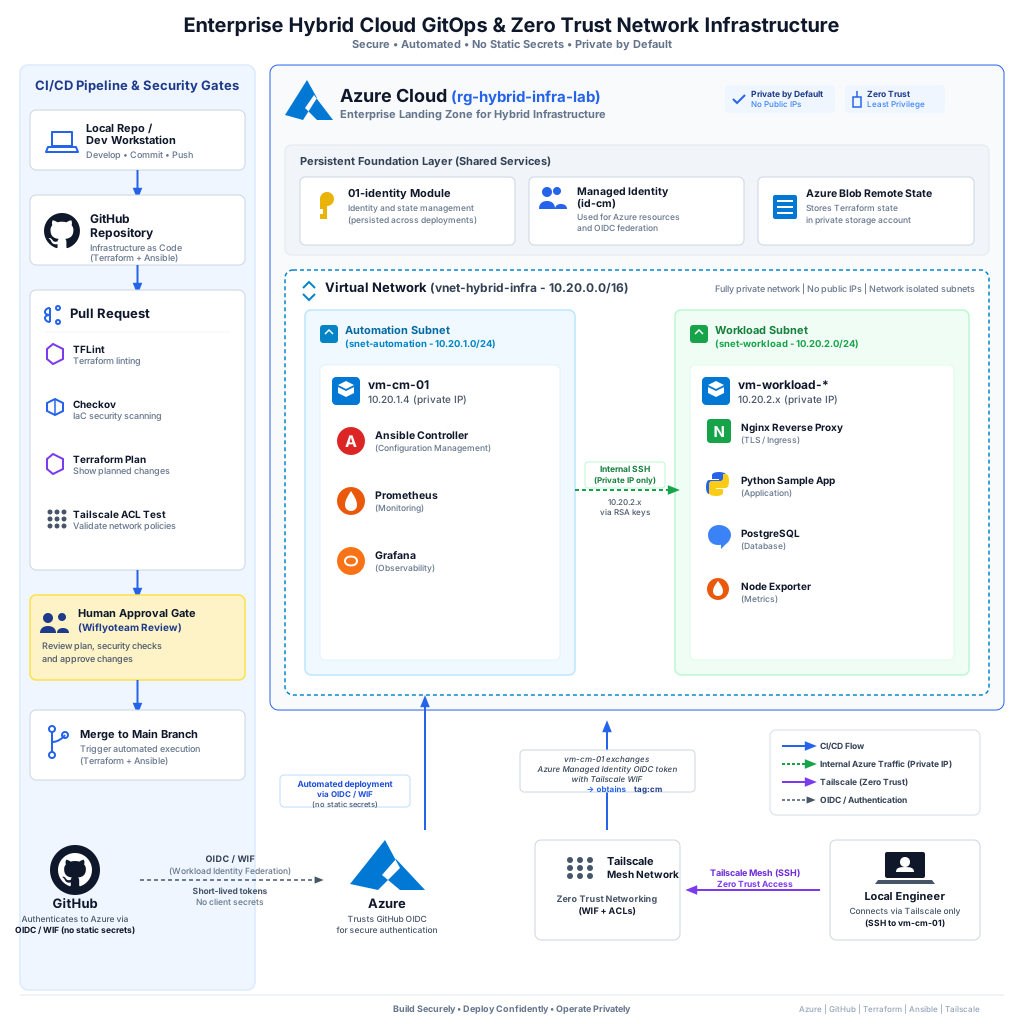
  1. 1 Explore the complete open-source codebase, HCL modules, Ansible playbooks, and automated CI/CD pipelines directly on my GitHub repository.
GitHub repository workflow and GitOps pipeline diagram

GitOps Automated Pipeline

Designed by An Huynh (Netop Lab)

Technology Stack Overview

Core Technologies & Purpose

Every tool in this lab is selected to fulfill specific enterprise requirements for security, automation, and maintainability.

Terraform

Used for declarative cloud resource provisioning (Azure VNets, VMs, NSGs) to ensure repeatable and version-controlled infrastructure.

Ansible

Automates server configuration baselines, package installations, and service management without storing long-lived SSH keys.

Azure Cloud

Provides enterprise-grade cloud compute and virtual networking foundations with flexible resource management.

GitHub Actions & OIDC

Enables keyless, secure authentication between CI/CD pipelines and Azure cloud resources using short-lived tokens.

Tailscale Mesh VPN

Establishes secure, encrypted private connectivity and policy-as-code access across distributed nodes without public exposure.

Key Lab Features & Capabilities

Built For Modern NetDevOps Operations

Discover how my lab [1]architecture empowers engineers to maintain absolute control over complex multi-site environments with minimal friction.

Note

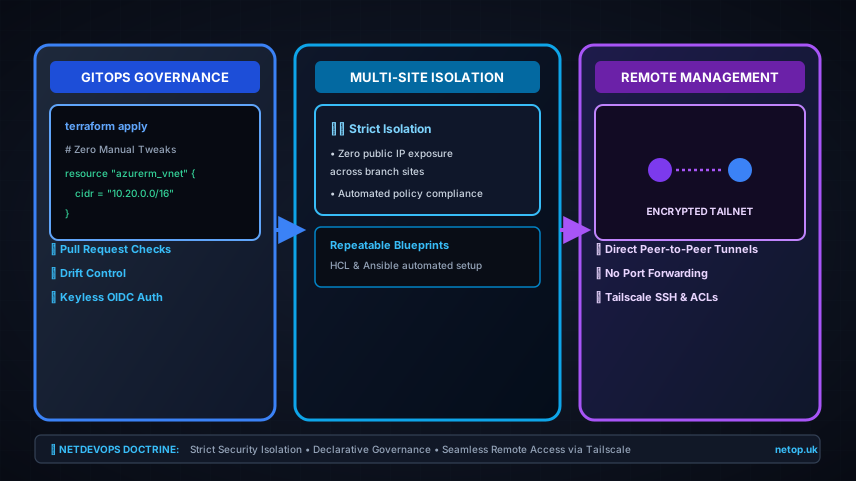
  1. 1 Enforces strict security isolation, declarative infrastructure governance, write-once-run-anywhere automation, and seamless remote management from anywhere via Tailscale.
Lab features and remote management topology diagram

NetDevOps Operational Flow

Security & Networking Standards

Production-Grade Security Components

Incorporating industry best practices as standard building blocks for high-security, scalable IaC projects.

WIF / OIDC Authentication

Eliminates long-lived secrets in CI/CD by using Workload Identity Federation.

Tailscale SSH & ACLs

Enforces fine-grained access policies and identity-based SSH connections.

Entra ID & RBAC

Applies least-privilege role-based access control across cloud resources.

NSGs & VNET Isolation

Restricts lateral movement with strict network security group rule boundaries.

No Public IP Footprint

Completely removes public IP exposure on virtual machines to minimize attack surfaces.

Scope, Limitations & Threat Model

Understanding Architectural Boundaries

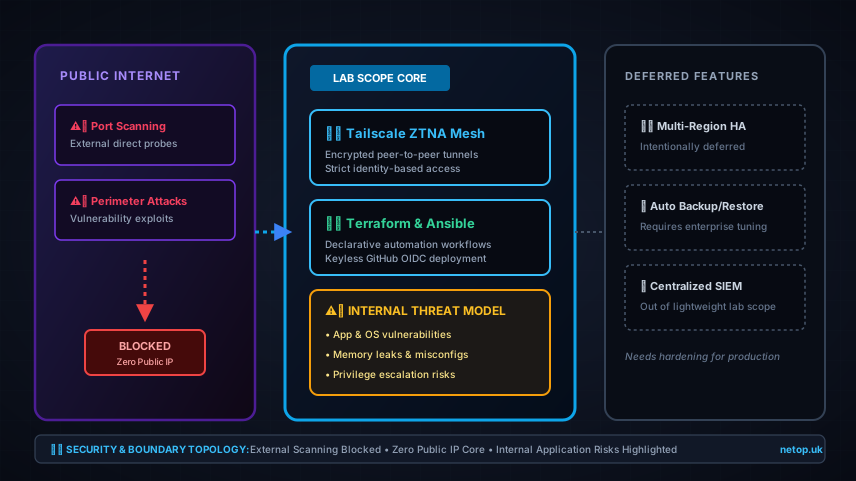
This project is a streamlined open-source[1] showcase. It intentionally defers advanced[2] enterprise features like multi-region HA, automated backup/restore, and centralized SIEM log aggregation.

Notes

  1. 1 Adapting this code for internal enterprise use requires custom hardening. External ingress modules (such as Cloudflare Tunnels or Load Balancers requiring public endpoints) must be implemented based on specific operational requirements.
  2. 2 While removing public IPs successfully neutralizes perimeter scanning and external direct attacks, it does not eliminate internal risks stemming from OS or application vulnerabilities, memory leaks, or privilege escalation.
Visual image Understanding Architectural Boundaries

Engineering Disclaimer

Production Validation & Expert Review

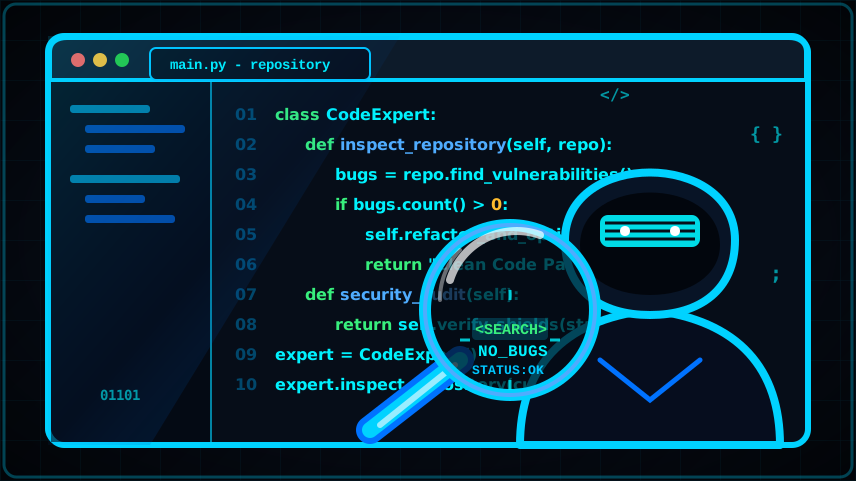
The repository provides a secure outer shell and robust automation baseline. However, core application security and compliance configurations must be thoroughly audited and certified by qualified security experts before running in mission-critical production environments.

Visual image Production Validation & Expert Review

Repository Walkthrough & Architecture Overview

Hybrid Infrastructure Lab Codebase Tour

Watch a complete repository overview explaining how the architecture operates, how the core automation components interact, and how to navigate the open-source codebase.

Frequently Asked Questions

Everything You Need To Know About The Solution

Clear answers regarding security posture, operational costs, production readiness, and licensing terms.

Is this solution secure and what are its limitations?

The lab implements strong zero-trust perimeter controls (no public IPs, OIDC authentication, Tailscale mesh). However, its primary limitation is the absence of built-in enterprise resilience (HA, disaster recovery) and internal application-layer defense, which require downstream hardening.

Does it incur high costs? How can expenses be managed?

Cloud resources (VMs, disks, egress bandwidth if applicable) incur standard provider charges while running. Fortunately, the repository includes a fully automated destroy mechanism to tear down all infrastructure immediately after testing, though users must actively monitor their Azure subscriptions.

Can this solution be deployed directly into real production?

While designed with production-grade patterns, it currently represents a foundational implementation. Deploying it for live enterprise traffic requires adding public ingress handling, high availability, comprehensive audit logging, and observability stacks.

Is it free and can it be commercialized?

The source code is released under the MIT License, excluding third-party modules, tool binaries (like Terraform), and proprietary software licenses. Always consult legal and technical experts before packaging this lab as a commercial product.